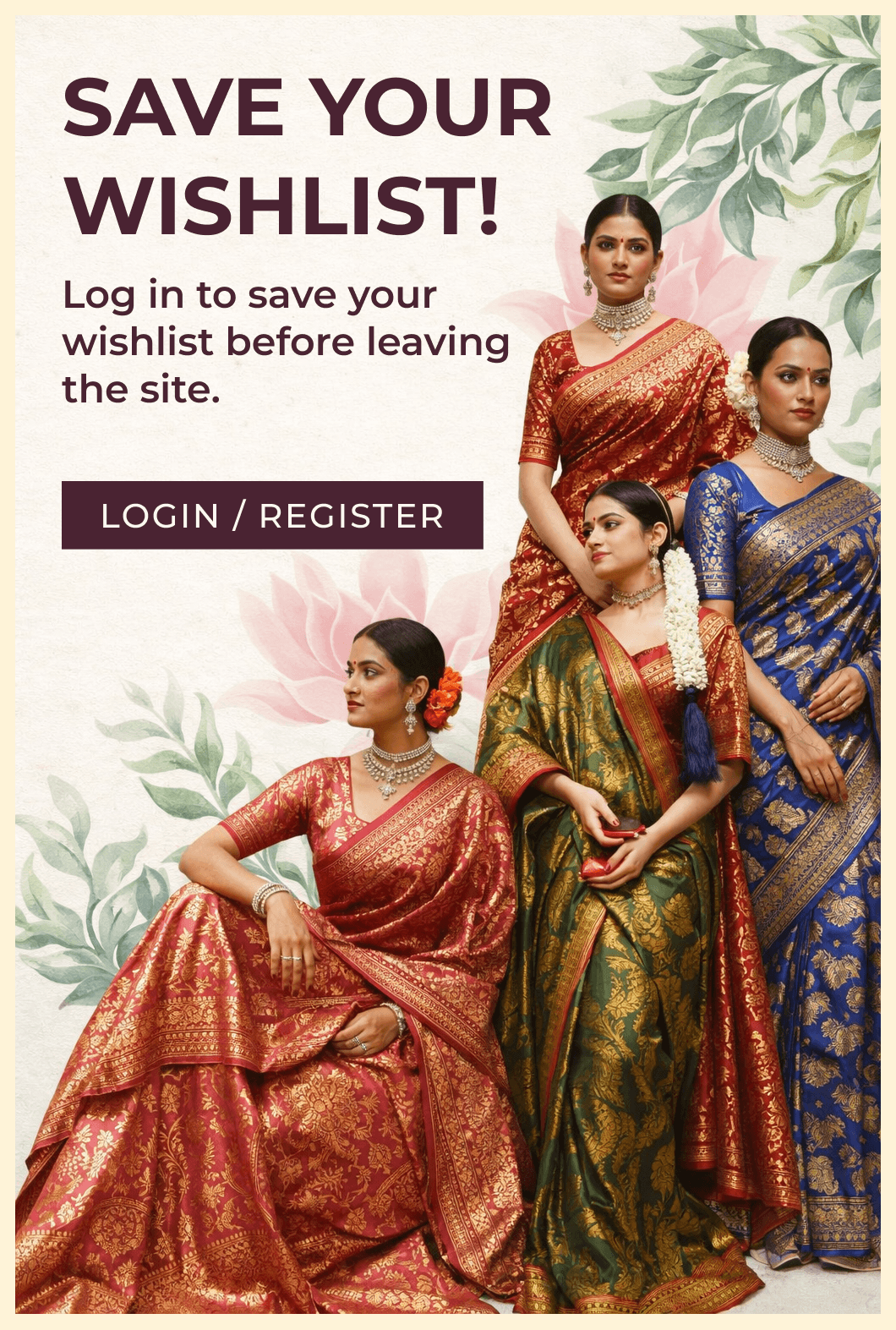
Here is an uncomfortable truth about the Banarasi saree market: for every genuine handwoven Banarasi saree sold in India today, there are dozens of imitations — machine-made, polyester-based, printed with a pattern that vaguely resembles brocade — being sold under the same name, at a fraction of the price, to buyers who have no way of knowing the difference.
This is not a new problem. The counterfeiting of Banarasi sarees has been documented for decades, and it is the single most common complaint among first-time buyers who discover, months after purchase, that the saree they paid ₹3,000 for was not silk at all. It is a betrayal that goes beyond money — because a Banarasi saree is rarely just a purchase. It is a wedding trousseau piece, a gift for a daughter, a saree saved for years before buying. Getting it wrong hurts.
This guide exists so that you never get it wrong. Below are 7 specific, practical checks that any buyer can perform — before purchase, without any special equipment — to distinguish a genuine Banarasi saree from an imitation. These are the same checks that experienced Varanasi karigar families use. At Kathanvi, every saree in our collection passes all seven before it reaches you.
Read this once. Keep it on your phone when you shop. Share it with anyone buying a Banarasi saree for the first time.
Use this table as your quick reference before diving into the detailed explanation of each check below.
# | Check | Original shows… | Imitation shows… |
|---|---|---|---|
1 | GI Tag / Certificate | GI hologram or brand authenticity cert | No tag, vague ‘pure silk’ stamp only |
2 | Reverse-side weave | Mirror brocade structure, floating threads visible | Printed pattern or uniform reverse — no floats |
3 | Silk burn test | Burns slow, hair smell, crushable ash | Melts/shrinks, acrid smell, hard bead residue |
4 | Zari quality (real vs fake) | Soft, non-tarnishing, warm to touch | Stiff, greenish tarnish, cold metallic feel |
5 | Texture & drape | Natural weight, warming to touch, fluid drape | Slippery, cold, static-prone, uniform texture |
6 | Weaver’s mark / selvedge | Woven name/signature on selvedge edge | Blank or printed selvedge |
7 | Price reality check | ₹2,000+ for genuine entry-level Banarasi | Under ₹800 — cannot be genuine handwoven silk |
Each check below is explained in detail: what to look for, why it matters, what an imitation looks like by contrast, and exactly how to perform the test yourself. Work through them in order when examining any Banarasi saree.
The Geographical Indication (GI) tag is the single most important legal marker of an authentic Banarasi saree. Granted by the Government of India in 2009, the GI certification means that only sarees woven by registered weavers in Varanasi and its recognised surrounding districts — Chandauli, Bhadohi, Jaunpur, and Mirzapur — can legally carry the Banarasi name.
An authentic GI-tagged Banarasi saree comes with a physical GI hologram label — a small, tamper-evident tag attached to the saree or its packaging, with a unique serial number that can be verified. The tag is issued by the Office of the GI Registry and the Banarasi weavers’ collective bodies. It is not something a manufacturer can print at home.
In practice, not every genuine handwoven Banarasi saree currently in the market carries a GI tag — the registration process is ongoing and many small karigar workshops sell through informal channels without formal tagging. This means the absence of a GI tag alone does not make a saree fake. But the presence of a verified GI tag is the strongest single piece of authentication a buyer can find.
✔ ORIGINAL GI hologram tag attached to saree or packaging, with verifiable serial number. Brand certificate stating fabric type, weave origin, and karigar details. | ✘ IMITATION No GI tag. Generic ‘Pure Silk’ stamp printed directly on packaging with no verifiable reference. Seller unable to provide weaver or origin documentation. |
✔ KATHANVI TIP: At Kathanvi, every saree comes with a fabric and origin certificate that details the fabric type (Katan, Georgette, Organza, etc.), the weave technique, and its Varanasi origin. This is our commitment in writing. Ask for it — from us, and from any Banarasi saree seller.
Turn the saree over and look at the reverse side. This is the single most reliable visual test for authenticity — and it is one that most buyers never think to perform.
In an authentic handwoven Banarasi saree, the brocade work is structural — the zari and coloured threads are woven into the fabric itself using the Jacquard loom technique. This means the reverse side of the saree shows the actual thread structure of the brocade: you will see the ‘floats’ — lengths of thread running horizontally across the back between the raised motifs — and a clear mirror image of the pattern on the face, albeit reversed and less refined.
The floats are the key. In a genuine Banarasi, the brocade threads travel across the back of the fabric between motif points, creating a pattern of loose horizontal threads on the reverse. In a printed or embroidered imitation, the reverse side is either perfectly uniform (a sign of printing) or shows machine embroidery stitching rather than the woven float structure.
Once you have seen the reverse of a genuine Banarasi a few times, identifying the float structure becomes almost instinctive. It looks nothing like either printing or embroidery — it is uniquely the signature of handloom weaving.
✔ ORIGINAL Reverse shows loose horizontal thread floats between motifs. Pattern is visible in mirror form on the back. The structure is clearly woven, not stitched or printed. | ✘ IMITATION Reverse is perfectly uniform and featureless (printed), or shows machine stitching with knotted thread ends (machine embroidery). No float structure visible. |
⚠ WARNING: Sellers sometimes try to disguise a printed saree by backing it with a contrast fabric, hiding the uniform reverse. If a saree has an attached lining sewn in before purchase, ask to see the actual reverse of the main fabric before buying.
The burn test is the most definitive way to confirm whether a saree is made of genuine silk or a synthetic substitute — and it can be performed with nothing more than a single loose thread and a lighter. In a shop, you can pull a single thread from the saree’s hem or fringe to test it without damaging the saree itself.
Real silk is a protein fibre, structurally similar to human hair. When burned, it behaves exactly like hair: it ignites slowly and reluctantly, continues burning only when the flame is held to it, self-extinguishes when the flame is removed, produces a smell that is unmistakably similar to burning hair, and leaves behind a small, dark, crushable ash that crumbles between the fingers.
Polyester and other synthetic fibres behave completely differently. They melt rather than burn, shrink away from the flame, smell acrid and chemical, and leave a hard, plasticky bead residue that does not crumble. Semi-silk and viscose blends show intermediate behaviour — burning more readily than pure silk but not melting — but the smell is sweet rather than the distinct protein smell of genuine silk.
This test works for any silk, not just Banarasi. If you are ever uncertain about whether any saree — regardless of what the seller claims — is genuine silk, this test is your definitive answer in under ten seconds.
✔ ORIGINAL Burns slowly, only while flame is applied. Self-extinguishes when flame removed. Smells like burning hair. Leaves dark, soft, crushable ash residue. | ✘ IMITATION Melts and shrinks from flame. Continues burning or smouldering after flame removed. Smells chemical or acrid. Leaves hard, non-crushable plastic bead residue. |
✔ KATHANVI TIP: Always test a thread from the fringe or the inner hem — never from the body or border of the saree. A single thread from the edge gives you all the information you need without any visible damage to the saree.
The zari — the gold or silver metallic thread that creates the brocade patterns and borders of a Banarasi saree — has its own distinct character that separates the genuine from the imitation. Real zari is made from a thin strip of real metal (gold or silver) wrapped around a core of silk or cotton thread. Imitation zari is made from metallic-coated polyester film wrapped around a synthetic core.
The difference in feel, behaviour, and appearance between real and imitation zari is significant — and becomes more obvious the more you handle Banarasi sarees.
Real zari has warmth to the touch — the silk or cotton core transmits body heat, giving the thread a slightly warm, organic feel. It is soft and pliable without being floppy, and it does not feel sharp or stiff against the skin. When rubbed gently, real zari does not flake, crumble, or leave metallic residue on the fingers. Over time, real zari tarnishes very slowly and develops a warm, antique patina rather than turning green or shedding metallic coating.
Imitation zari — often called ‘tested’ or ’tissue’ zari in the market — is noticeably stiffer, cooler to the touch, and has a harsher, sharper sheen that is uniform rather than organic. It can flake or shed metallic coating when rubbed firmly. Within months to a year of regular use, imitation zari often turns greenish or loses its lustre entirely — something that should never happen to real zari over a lifetime of careful use.
✔ ORIGINAL Warm to the touch, soft and pliable. Natural, slightly varying sheen — not uniformly metallic. Does not flake or leave residue when rubbed. Tarnishes slowly to warm patina over years. | ✘ IMITATION Cool and stiff, often sharp against skin. Uniformly bright, plastic-looking sheen. May flake or leave metallic residue when rubbed. Turns green or dull within months of use. |
⚠ WARNING: The term ‘tested zari’ is commonly used in the saree market to describe imitation metallic thread. Despite the word ‘tested’ suggesting quality, it means the opposite: it is zari that has been tested and found to not contain real metal. Always ask specifically: ‘Is this real zari or tested zari?’
Genuine silk has a suite of physical properties that no synthetic fabric has successfully replicated — and experienced hands can identify them in seconds. This check requires no tools and no test strips. It requires only your hands and a few moments of careful attention.
Hold a section of the saree in your palms and close your hands around it gently. Genuine silk will warm to your body temperature almost immediately — because silk is a protein fibre with natural thermal conductivity that responds to warmth. Polyester and synthetic blends remain noticeably cooler and do not warm in the same way.
Now let the fabric slide through your fingers. Genuine silk has a characteristic smoothness that is distinct from the slipperiness of polyester. Silk moves with resistance — it has body and weight behind the smoothness. Polyester slides with almost frictionless ease, and it tends to create static, clinging to itself and to skin. Silk does not static-cling.
The drape is perhaps the most telling quality of all. Genuine Katan silk, when held up and allowed to fall, hangs with a structured weight — it maintains the form of a fold rather than collapsing entirely. Georgette silk falls with fluid movement but has a slight resistance. Polyester hangs limply and uniformly, with no structural memory.
Finally, pass the fabric through a closed fist and listen. Pure silk produces a soft, distinctive rustling sound — the characteristic ‘scroop’ of real silk that no synthetic has been able to reproduce authentically. If the saree is silent as it passes through your hand, it is most likely synthetic.
✔ ORIGINAL Warms to body temperature quickly. Smooth with body and resistance — not frictionless. No static cling. Drapes with structural memory and weight. Produces a soft scroop sound when compressed. | ✘ IMITATION Remains cool and uniform in temperature. Slippery and frictionless, static-prone, clings to itself. Drapes limply with no structural memory. Silent when compressed — no scroop. |
✔ KATHANVI TIP: The scroop test is best performed in a quiet moment away from the noise of a busy shop floor. Pass a folded section of the saree through your closed fist slowly. The soft rustle of real silk is unmistakable once you have heard it — and you will never mistake polyester for it again.
The selvedge is the finished edge of the saree that runs along its length — the narrow border that prevents the fabric from fraying. In an authentic handwoven Banarasi saree, the selvedge is often where the weaver leaves their mark.
Traditionally, karigar families in Varanasi wove their name, their workshop identifier, or a specific design element into the selvedge of their sarees — a practice that both authenticated the work and connected the saree permanently to its maker. This is not a modern quality-control innovation. It is a centuries-old tradition of artisan pride and accountability.
When examining a Banarasi saree, look at the selvedge edge — the narrow, plain border running along the length. In an authentic piece, you may find: the weaver’s name woven in fine thread, a specific geometric pattern unique to the workshop, or the word ‘Banarasi’ woven into the edge. The selvedge on a genuine handloom saree also has a characteristic slightly irregular texture — the natural result of hand-tension variations during weaving — that machine-produced selvedges do not replicate.
Not every authentic Banarasi carries a clearly woven weaver’s mark — particularly in the more affordable price ranges where shorter production cycles are common. But the presence of a woven mark is one of the strongest authenticity signals available, and its absence on a high-value piece deserves scrutiny.
✔ ORIGINAL Selvedge may show woven weaver’s name, workshop mark, or ‘Banarasi’ identification. Slightly irregular texture from natural loom tension variation. Clean, structurally woven finish. | ✘ IMITATION Blank selvedge with no identification. Perfectly uniform texture — sign of machine production. Sometimes has printed or adhesive labels rather than woven marks. |
✔ KATHANVI TIP: At Kathanvi, we maintain a record of the karigar workshop and weave source for every saree in our collection. Ask us, and we will tell you exactly which karigar family wove your saree and where their workshop is in Varanasi. This traceability is something only a brand with genuine on-the-ground roots can offer.
This is the check that requires no physical examination, no special knowledge, and no time at all — and it is the one most often ignored in the excitement of a good-looking saree at a low price.
Here is the economic reality of making a genuine Banarasi saree. Raw Katan silk costs significantly more per metre than polyester. Real zari is priced by the gram weight of actual precious metal content. A single karigar earns between ₹400 and ₹800 per working day. Even the simplest authentic Banarasi saree — a plain Georgette Butidar with modest zari work — requires 2 to 3 days of skilled karigar time to complete.
The arithmetic is straightforward. Add the cost of genuine silk, real or semi-real zari, karigar wages, quality checking, and even the most modest commercial margin — and you arrive at a floor price below which a genuine Banarasi saree simply cannot exist.
That floor is approximately ₹2,000 for the simplest authentic entry-level piece at current material and labour costs. A saree sold to you for ₹500, ₹800, or ₹1,200 as a ‘Banarasi saree’ is, by economic necessity, not what it claims to be. The seller is either using polyester instead of silk, printed patterns instead of woven brocade, imitation zari, or all three simultaneously.
This does not mean that expensive always means authentic — the market for overpriced imitations exists at every price point. But it does mean that a suspiciously low price is the first and most reliable warning signal, and no amount of persuasive selling should override it.
✔ ORIGINAL Genuine Banarasi entry price: ₹2,000+ for Organza/Kora Butidar. ₹2,500+ for Georgette. ₹4,500+ for Katan Silk. Price reflects actual material and labour cost. | ✘ IMITATION Sarees sold as ‘Banarasi’ under ₹1,500 cannot be genuine handwoven silk with real zari. Price below floor = synthetic fabric, printed pattern, or imitation zari — or all three. |
⚠ WARNING: The phrase ‘factory price’ or ‘wholesale price’ is commonly used to explain suspiciously low Banarasi saree prices. There is no factory model that makes genuine handwoven silk sarees cheaper than ₹2,000 — because ‘handwoven’ and ‘factory’ are, by definition, mutually exclusive. A genuine Banarasi must be woven on a loom by a human being. That time has a cost that no factory model can eliminate.
Online saree buying introduces an obvious challenge: you cannot touch the fabric, perform the burn test, or examine the reverse side through a screen. For NRI buyers and anyone shopping from outside Varanasi, this is a real problem — and it is one that the imitation saree market actively exploits through carefully filtered photography and misleading product descriptions.
Here is how to adapt the 7-check framework for online purchasing.
Every saree in the Kathanvi collection is sourced directly from karigar families in Varanasi. We do not buy from intermediaries, distributors, or wholesale markets where provenance becomes unclear. We know the looms our sarees come from — and in many cases, we know the specific karigar who sat at that loom.
Before any saree is listed on Kathanvi, it is checked against all seven criteria in this guide: fabric composition, reverse weave structure, zari quality, drape and texture, and the physical origin documentation from the karigar. Every saree comes with a fabric and origin certificate as standard — not as a premium add-on, but as our baseline commitment to every buyer.
We built Kathanvi because we watched too many women — including women in our own families — buy Banarasi sarees that turned out to be imitations. The knowledge in this guide is the knowledge that should have been available to them before that purchase. We are sharing it freely because an informed buyer is a protected buyer — and because the karigar in Varanasi whose livelihood depends on people choosing genuine handwoven silk deserves buyers who can tell the difference.
If you ever have a question about a Kathanvi saree — its fabric, its origin, its karigar, its zari — ask us. We will answer with full transparency. That is not a promise. It is a policy.
Browse the Kathanvi collection of authentic, karigar-verified Banarasi sarees, starting at ₹2,000.
Q: How do I identify an original Banarasi saree?
A: To identify an original Banarasi saree, check for: (1) a GI tag or authenticity certificate, (2) visible thread floats on the reverse side — a sign of genuine handloom weaving, (3) the silk burn test — real silk burns slowly, smells like hair, and leaves crushable ash, (4) soft, warm zari that does not flake, (5) fabric that warms to body temperature and produces a soft scroop sound, (6) a weaver’s mark on the selvedge edge, and (7) a price above ₹2,000 — genuine handwoven Banarasi silk cannot be made for less.
Q: What is the burn test for Banarasi sarees?
A: The burn test involves pulling a single thread from the saree’s fringe or inner hem and burning it carefully. Genuine silk burns slowly, only while the flame is applied, self-extinguishes when the flame is removed, smells like burning hair, and leaves a small, dark, crushable ash. Polyester and synthetic imitations melt, shrink from flame, smell acrid or chemical, and leave a hard plastic bead that does not crumble.
Q: What is a GI tag for Banarasi sarees?
A: A GI (Geographical Indication) tag for Banarasi sarees is a government-issued certification that legally verifies the saree was woven in Varanasi or its surrounding districts (Chandauli, Bhadohi, Jaunpur, Mirzapur). The tag, granted in 2009, comes as a physical hologram label with a verifiable serial number. Its presence is the strongest single authenticity marker available to buyers.
Q: How can I tell if a Banarasi saree is real silk or polyester?
A: Three tests help distinguish real silk from polyester in a Banarasi saree: (1) The burn test — silk burns like hair; polyester melts with an acrid smell. (2) The warmth test — real silk warms to body temperature; polyester stays uniformly cool. (3) The scroop test — silk makes a soft rustling sound when compressed; polyester is silent. The drape of real silk also has natural weight and memory that polyester cannot replicate.
Q: What is the minimum price of a genuine Banarasi saree?
A: A genuine handwoven Banarasi saree cannot be produced for less than approximately ₹2,000 at current material and labour costs — and that is for the simplest entry-level Organza or Georgette Butidar piece with modest zari work. Katan Silk Banarasi sarees start at ₹4,500 for genuine pieces. Any saree sold as ‘Banarasi’ below ₹1,500 is almost certainly a synthetic imitation.
Q: What does the reverse side of a genuine Banarasi saree look like?
A: The reverse side of an authentic handwoven Banarasi saree shows loose horizontal thread floats between the brocade motifs — lengths of zari or coloured thread that run across the back between pattern points. The pattern itself is visible in mirror form on the reverse. A printed or machine-embroidered imitation shows either a perfectly uniform reverse (printing) or machine stitching without float structure (embroidery).
Q: What is the difference between real zari and tested zari?
A: Real zari is made from actual metal (gold or silver) wrapped around a silk or cotton core — it is warm to the touch, soft, and develops a slow patina over time without turning green. Tested zari is imitation metallic thread made from metallic-coated polyester film — it is stiffer, cooler, often sharper against skin, and can flake, shed coating, or turn greenish within months of regular wear.
Q: Can I check if a Banarasi saree is original when buying online?
A: Yes. When buying online, request reverse-side photographs from the seller — genuine sellers provide these readily. Check the product description carefully: phrases like ‘Banarasi style,’ ‘Banarasi print,’ or ‘Banarasi work’ indicate the saree is not genuinely Banarasi. Verify the price is above ₹2,000. Ask the seller directly about fabric composition, zari type (real or tested), and origin details. Choose brands that provide fabric and origin certificates with purchase.
Q: What is the weaver’s mark on a Banarasi saree?
A: The weaver’s mark is a name, workshop identifier, or specific pattern element woven into the selvedge edge of an authentic Banarasi saree by the karigar. It is a centuries-old tradition of artisan identification and accountability. Its presence is a strong authenticity signal — particularly on higher-value pieces. The selvedge of a genuine handloom saree also has slightly irregular texture from natural loom tension variation, unlike the perfectly uniform selvedge of machine-made alternatives.
Q: Are cheap Banarasi sarees always fake?
A: Yes, below a certain price point. A genuine handwoven Banarasi saree has irreducible material and labour costs that set a floor price of approximately ₹2,000 for the simplest authentic piece. Sarees sold as ‘Banarasi’ under ₹1,500 cannot be genuine handwoven silk with authentic zari — the economics simply do not allow it. Above ₹2,000, price alone is not a guarantee of authenticity, but below it, inauthenticity is virtually certain.
The seven checks in this guide take less than five minutes to perform. They require no tools beyond your hands, a lighter, and a single loose thread from the hem. And they stand between you and a purchase you will regret.
The karigar in Varanasi who spent two weeks weaving the saree you are about to buy deserves to have their work recognised and valued at its actual worth. The imitation seller who undercuts that karigar by ₹2,000 deserves to lose that sale. Your ability to tell the difference is what makes both of those things happen.
At Kathanvi, we welcome scrutiny. Examine our sarees against every check on this list. Ask us for the reverse-side photographs, the karigar details, the fabric composition certificate. We provide all of it because we have nothing to hide — and everything to demonstrate.
Authentic Banarasi sarees, sourced directly from Varanasi karigar families, starting at ₹2,000. Shop the Kathanvi collection with the confidence of knowing exactly what you are buying.
All Sales Are Final
We do not accept returns or refunds once an order is placed.
Order Cancellation
Orders cannot be cancelled after confirmation.
Damaged Product Exchange
Store Credit Only
No cash refunds. Only store credit is issued.