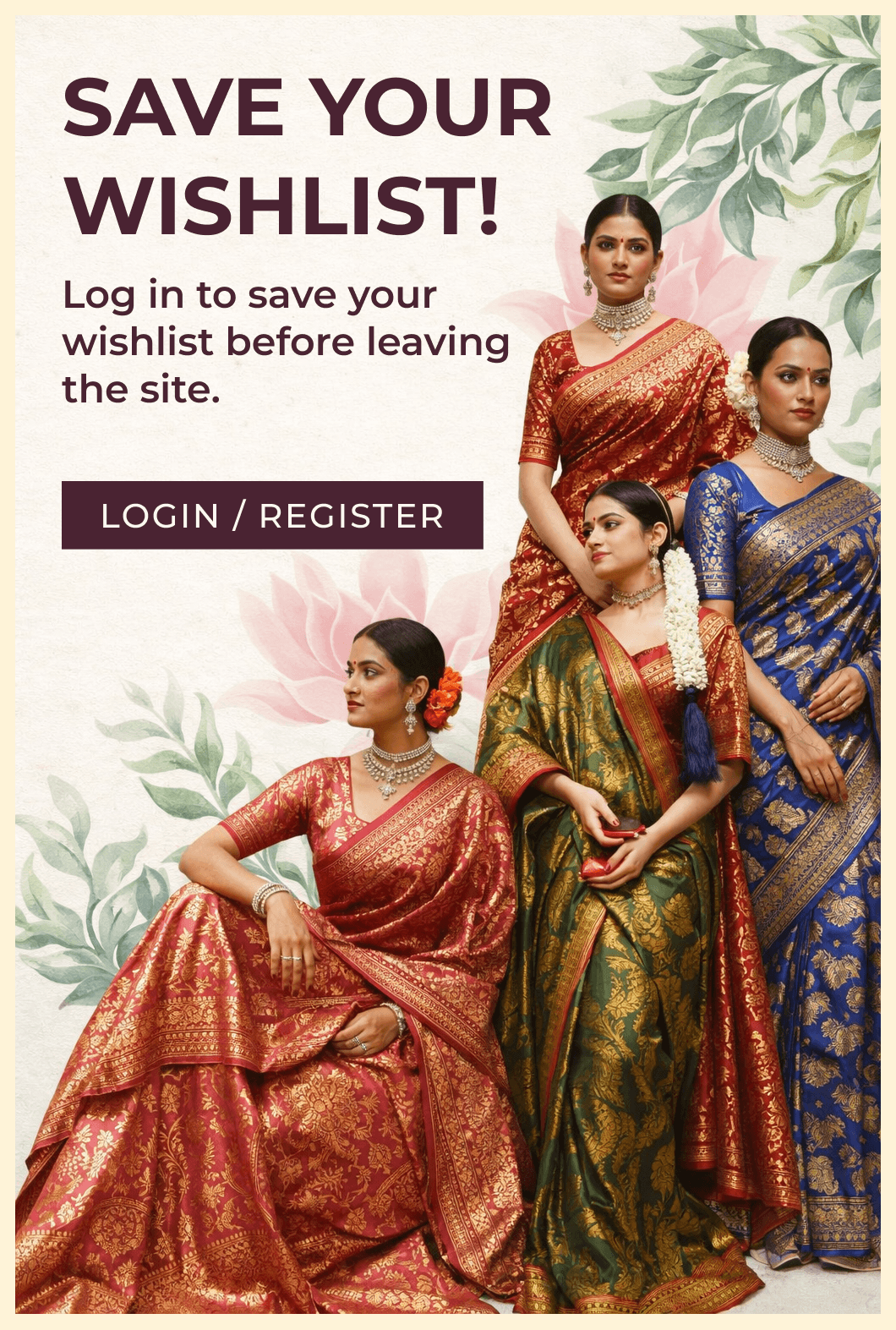
An Indian wedding is not a single moment. It is a sequence of ceremonies — the mehendi, the haldi, the sangeet, the pheras, the reception — each with its own visual register, its own emotional weight, and its own unspoken dress code. And within each of those ceremonies, there is not one woman making a sartorial decision. There are many.
The bride, certainly. But also the mother of the bride, who has been waiting for this day for decades. The mother of the groom, who carries the weight of welcome on her shoulders. The sister of the bride, who wants to look beautiful but knows that today is not her day. The bridesmaids, who want to be coordinated without being costumes. The aunts, the cousins, the close family friends — every one of them is asking the same question: which saree, for which ceremony, in which role?
The answer — for women who want elegance, heritage, and the kind of beauty that actually photographs well — almost always involves Banarasi.
But not every Banarasi saree is right for every wedding role. The bride’s Katan Jangla and the bridesmaid’s Georgette Butidar are both Banarasi. They both carry the DNA of Varanasi. But they occupy entirely different positions in the visual grammar of a wedding. Choosing correctly between them — and across the full range of Banarasi fabric types, motif vocabularies, and colour traditions — is what this guide is written to help you do.
This is the complete Banarasi wedding guide: one role at a time, one ceremony at a time, with the practical detail that makes a decision easy.
Before moving to individual roles, it is worth understanding why Banarasi sarees have held their position at the centre of North Indian wedding dressing for centuries — and why that position has not diminished in the age of lehengas, designer fusion wear, and international bridal fashion.
The answer has three parts.
Heritage that carries meaning
A Banarasi saree is not simply a beautiful garment. It is a piece of Varanasi — woven by karigar families in a tradition that stretches back five centuries, through Mughal patronage, through partition, through every economic pressure that threatened to erase it. When a woman wears Banarasi at her wedding, she is wearing that history. She is connecting herself to a lineage of craft that has dressed brides across generations. That meaning is not decorative. It is real, and it is felt.
Visual richness that no other garment matches
The gold and silver zari brocade of a Banarasi saree — woven structurally into the silk during weaving itself, not embroidered on afterward — creates a depth and luminosity that no other textile tradition in India replicates in quite the same way. Under ceremony lighting, in outdoor photographs, in the dancing light of a wedding mandap, a well-chosen Banarasi saree glows. It does not merely reflect light; it seems to hold it.
A range that accommodates every wedding need
Banarasi sarees span from the heaviest Katan Silk Jangla — dense brocade across the entire body, substantial enough to drape like armour and move like water — to the most gossamer Organza, barely-there in weight but extraordinary in its shimmer. This range means that every woman at a wedding, regardless of her role, her body, her comfort preferences, or the season of the wedding, can find a Banarasi saree that is genuinely right for her.
The bride’s Banarasi saree is the most important choice in the entire wedding wardrobe — and it is also the most individual. No formula can substitute for the bride’s own instinct about what she wants to wear on the most photographed day of her life. But there are clear principles that guide the best choices.
Fabric first
For a North Indian wedding pheras, Banarasi Katan Silk is the traditional choice, and it remains the finest for good reason. Katan is the heaviest Banarasi silk — a tightly twisted double-thread weave that creates a fabric with substance, drape, and a characteristic rustle as it moves. It photographs beautifully, holds its shape through long ceremonies, and ages into an heirloom. A Katan Jangla or Katan Meenakari in deep red, magenta, or royal blue is as close to a definitive bridal Banarasi as the tradition has ever produced.
For summer or destination weddings, or for brides who find heavy silk uncomfortable, Banarasi Georgette is the alternative that sacrifices nothing in beauty. For brides who want drama without weight, Banarasi Tissue or Organza are the answers.
Motif vocabulary
The Jangla motif — an all-over dense field of flowering vines, leaves, and blooms covering the entire body of the saree — is the most traditionally prestigious Banarasi bridal pattern. For brides who want a slightly less dense visual presence, the Butidar offers elegance with more breathing room. The Shikargah pattern, featuring the Mughal hunting scene narrative across the fabric, is spectacular and rare — a statement for a bride who wants something that starts a conversation.
Colour
The Banarasi bridal colour tradition runs toward deep reds — particularly the specific dark red-magenta that Varanasi weavers call gulabi lal — along with rich magentas, deep teals, royal blues, and ivory. Ivory Banarasi sarees with heavy gold zari have become a significant modern bridal choice, particularly for receptions and for brides who want an alternative to red without abandoning tradition.
Bridal Saree by Wedding Function
Wedding Function | Recommended Fabric | Motif | Colour Direction |
Pheras / Main Ceremony | Katan Silk | Jangla or Meenakari | Deep red, magenta, royal blue |
Reception | Tissue or Organza | Butidar or Jangla | Ivory, gold, champagne, deep teal |
Mehendi | Georgette | Butidar or Jali | Yellow, green, coral, peacock blue |
Sangeet | Georgette or Organza | Butidar | Bright jewel tones, pastels |
Post-wedding functions | Georgette | Butidar or Shikargah | Any; lighter colours work beautifully |
The mother of the bride occupies a position at a wedding that requires a very specific visual intelligence: she must be present and beautiful, but she must not compete with her daughter. At the same time, she cannot be invisible — she is one of the two most photographed women at the event.
The right Banarasi saree for a mother of the bride solves this equation elegantly. The answer is almost always Katan Silk or Georgette in a colour that is complementary to the bride’s palette rather than a match for it. If the bride is in red, the mother might wear a deep teal, a rich mauve, or an ivory.
For the pheras, a Katan Butidar or a Katan Shikargah — substantial, elegant, and clearly expensive without trying to upstage brocade-for-brocade — is ideal. For the reception, where the evening’s light calls for shimmer, a Tissue Silk or an Organza allows the mother to glow in the photography without standing in her daughter’s light.
A word about comfort. Many mothers of the bride are wearing a saree for long hours — through the mandap, the pheras, the receiving line, the photographs, the dinner. If the mother is not accustomed to heavy Katan, a Georgette Banarasi with a significant zari pallu gives the visual weight of a formal saree with the physical ease of a lighter fabric.
The mother of the groom holds mirror-image stakes to the mother of the bride — equally photographed, equally significant, equally bound by the visual logic of complementing without competing. The primary consideration here is coordination with the groom’s side: if there is a colour theme for the baraat or the groom’s family, the mother’s saree should anchor rather than clash with it.
Beyond colour, the same principles apply: Katan or Georgette for the main ceremony, Tissue or Organza as a reception option for those who want shimmer.
The sister of the bride is at a wedding as a participant, a support, and a presence — but not as a lead. Her Banarasi saree should be beautiful enough to honour the occasion and her relationship to the bride, without being so spectacular that it reads as competition.
Banarasi Georgette Butidar sarees are ideally suited to this role. The fabric is elegant and clearly silk; the Butidar motif gives structure and pattern without the all-over density of a Jangla; and Georgette’s drapeability makes it easier to wear through a long, physically active wedding day that involves carrying things, hugging people, and dancing late.
For bridesmaids in Banarasi sarees, the key consideration is coordination. A set of Banarasi Georgette Butidar sarees in the same colour — or in closely related tones — creates one of the most beautiful visual effects in Indian wedding photography: the depth and texture of genuine woven silk, in a coordinated palette that anchors the bridal group without swallowing it.
For guests attending a wedding where saree is the appropriate dress code, a Banarasi saree signals respect for the occasion, genuine investment in the relationship, and a level of visual presence that is appropriate to a significant celebration.
For guests, the full range of Banarasi fabrics is available — the decision should be driven by the season, the venue (indoor/outdoor, day/evening), and the guest’s own aesthetic preferences. The principal guideline for guests is colour: avoid the deep red associated with the bride, and where possible, learn whether there is a family colour code that should be observed or avoided.
The Complete Wedding Role Decision Table
Your Role | Best Fabric | Best Motif | Colour Strategy |
Bride — Pheras | Katan Silk | Jangla / Meenakari | Deep red, magenta, royal blue |
Bride — Reception | Tissue / Organza | Jangla / Butidar | Ivory, champagne, gold, teal |
Bride — Mehendi / Sangeet | Georgette | Butidar / Jali | Yellows, greens, coral, bright jewels |
Mother of Bride | Katan or Georgette | Butidar / Shikargah | Complement bride — not match |
Mother of Groom | Katan or Georgette | Butidar | Coordinate with groom’s side colour |
Sister of Bride | Georgette | Butidar | Coordinate with wedding palette |
Bridesmaids | Georgette | Butidar | Coordinated tones — not identical to bride |
Wedding Guest — Formal | Katan or Georgette | Any | Avoid deep bridal red; festive jewel tones |
Wedding Guest — Semiformal | Organza or Georgette | Butidar | Pastels, warm neutrals, mid-tones |
NRI Bride / Destination Wedding | Organza or Georgette | Butidar / Jangla | Ivory, pastels, or signature jewel tone |
No wedding role decision is complete without considering the physical context of the wedding. A December wedding in Delhi and a May wedding in Mumbai ask very different things of a silk saree.
Winter weddings (October–February, Northern India)
Katan Silk becomes not just appropriate but genuinely comfortable. Its weight adds warmth, and its structure holds beautifully in the dry winter air. This is the optimal season for the heaviest Banarasi sarees.
Summer and monsoon weddings (March–September)
Banarasi Georgette and Organza are the right choices for any role. Both are genuine silk, both carry real zari work and Banarasi motifs, and both are light enough to wear comfortably through ceremonies in heat and humidity.
Indoor air-conditioned venues
Katan and Tissue are ideal — the controlled environment removes the weight concern, and the dramatic visual presence of heavier Banarasi fabrics reads beautifully in the close spaces and controlled lighting of banquet halls.
Outdoor ceremonies and garden weddings
Georgette and Organza. Both drape naturally in light breezes, and both photograph beautifully in natural light — Organza in particular has a sheerness that catches sunlight in ways that no indoor photograph fully captures.
One of the most elegant effects in Indian wedding photography comes from coordinating Banarasi sarees across a group — bridesmaids, sisters, female cousins — without making the coordination feel like a uniform. The way to achieve this is through consistency of fabric type and motif, with variation in colour.
A group of women all wearing Banarasi Georgette Butidar sarees in closely related tones — say, different shades of pink from coral to dusty rose to deep magenta — creates a visual cohesion that reads beautifully in photographs while allowing each woman to wear the specific shade that suits her.
Planning a wedding wardrobe from outside India involves an additional layer of consideration that domestic buyers rarely have to manage: everything must be chosen, confirmed, and shipped months in advance, without the ability to walk into a store, feel the fabric, or hold the saree up to natural light.
For NRI families, the most important decisions to make before ordering are:
Fabric weight relative to venue. If the wedding is in India in the months of October through February, weight is your friend. If it is in a Western country where wedding venues are air-conditioned and the bride will be on her feet for six hours, prioritise Georgette or Organza.
Colour in photographs. Banarasi colours are extraordinary in person; in photographs, the effect depends on the lighting. Deep reds and magentas are dramatically photogenic under warm ceremony lighting. Ivory and gold are luminous in both natural and artificial light.
Drape and comfort during travel. For sarees being worn at overseas wedding venues, Georgette is the most forgiving fabric for non-expert drapers. Its weight naturally settles into a graceful drape with minimal manipulation.
Kathanvi ships internationally with full fabric care documentation and packaging designed for long-distance travel. Every saree in the collection is sourced directly from karigar families in Varanasi — the same weaving lanes that have been dressing Indian brides for five centuries.
Optimised for Google Featured Snippets, AI Overviews & Voice Search
Q: Which Banarasi saree is best for a bride?
For the main wedding ceremony (pheras), Banarasi Katan Silk in a Jangla or Meenakari pattern is the most traditional and prestigious choice — its weight, drape, and all-over brocade create the fullest ceremonial presence. For receptions, Banarasi Tissue or Organza offers shimmer and lightness. For summer or destination weddings, Banarasi Georgette is the best alternative — genuine silk, genuine Banarasi brocade, and significantly more comfortable in heat.
Q: What colour Banarasi saree is best for a wedding?
For the bride, deep reds, magentas, and royal blues are the most traditional and photographically powerful choices. Ivory with gold zari has become a strong modern bridal option. For other wedding roles, any colour except deep bridal red works — jewel tones, warm neutrals, pastels, and rich greens all translate beautifully into Banarasi weaving.
Q: What Banarasi saree should the mother of the bride wear?
The mother of the bride should choose a Banarasi saree in a colour that complements rather than matches the bride. Katan Silk or Georgette in deep teal, rich mauve, emerald, or wine are classic choices when the bride is in red. The motif should be elegant and substantial — a Butidar or Shikargah — without being as visually dense as the bride’s Jangla.
Q: Can bridesmaids wear Banarasi sarees?
Absolutely. Banarasi Georgette Butidar sarees in coordinated colours are one of the most elegant bridesmaid choices in Indian wedding dressing. The fabric is genuine silk, the motif reads consistently across a group, and the colour can be varied within a single palette to give each bridesmaid individuality within visual unity.
Q: Which Banarasi saree fabric is best for a summer wedding?
Banarasi Georgette and Banarasi Organza (Kora) are both excellent for summer weddings. Both are genuine silk with authentic Banarasi brocade, but their construction makes them significantly lighter and more breathable than Katan Silk. Organza is the lightest of all Banarasi fabrics and drapes beautifully in outdoor settings and natural light.
Q: Is a Banarasi saree appropriate for a South Indian wedding?
Yes. While Kanjivaram is the traditional choice for South Indian brides within their own ceremony context, Banarasi sarees are worn with great pride by South Indian women at mixed-cultural weddings, receptions, and functions that call for cosmopolitan Indian dressing. There is no occasion where a beautiful Banarasi saree is inappropriate for any Indian woman, regardless of regional background.
Q: How do I coordinate Banarasi sarees for a wedding party?
The most elegant method is to keep the fabric type and motif consistent while varying the colour within a close palette. A group of Banarasi Georgette Butidar sarees in shades of pink — from coral to deep magenta — creates visual cohesion in photography while allowing each woman to wear her best colour.
Q: What Banarasi saree is best for a wedding reception?
For the reception, where artificial lighting often includes warm spotlights and the occasion calls for shimmer over pure ceremony, Banarasi Tissue Silk or Banarasi Organza are outstanding choices. Tissue’s characteristic metallic shimmer and Organza’s sheerness both read beautifully under reception lighting and in evening photography.
Q: What is the most traditional Banarasi bridal saree?
The most traditional Banarasi bridal saree is a Katan Silk Jangla in deep red — a dense all-over brocade of flowering vines and Mughal floral motifs woven in gold zari on a deep red or magenta silk ground. This is the saree that appears in centuries of North Indian wedding photographs and paintings, and it remains the definitive statement of Banarasi bridal tradition.
Q: How do I choose a Banarasi saree for a wedding guest?
As a wedding guest, choose a fabric that matches the formality of the event — Katan for a highly formal ceremony, Georgette or Organza for more relaxed celebrations or warm-season weddings. Avoid the deep red associated with the bride. Beyond that, choose the colour and motif that you find personally beautiful — a wedding is a celebration, and there is no wrong choice within those two guidelines.
A wedding is a collective ceremony. Its beauty is not contained in the bride alone — it is distributed across every woman who dressed with care and intention for the occasion. Every woman who understood that her presence, her colour, her fabric, was a contribution to the visual story of the day.
Banarasi sarees are the textile tradition that has always understood this. The tradition has always produced sarees for the bride and for her mother, for the sister who stands beside her and for the aunt who has known her since childhood. The karigar families of Varanasi have been weaving for weddings — for all of the women at weddings — for five centuries.
Kathanvi carries that tradition. Our collection spans every role, every ceremony, every season of a wedding year, across the full range of Banarasi fabric types and motif vocabularies. Every piece in the collection is sourced directly from the weaving families of Varanasi — because we are from Banaras, because we know these lanes, and because the integrity of what we carry begins where it has always begun: at the loom.
If your wedding is coming — or if someone you love is being married — begin here.

All Sales Are Final
We do not accept returns or refunds once an order is placed.
Order Cancellation
Orders cannot be cancelled after confirmation.
Damaged Product Exchange
Store Credit Only
No cash refunds. Only store credit is issued.