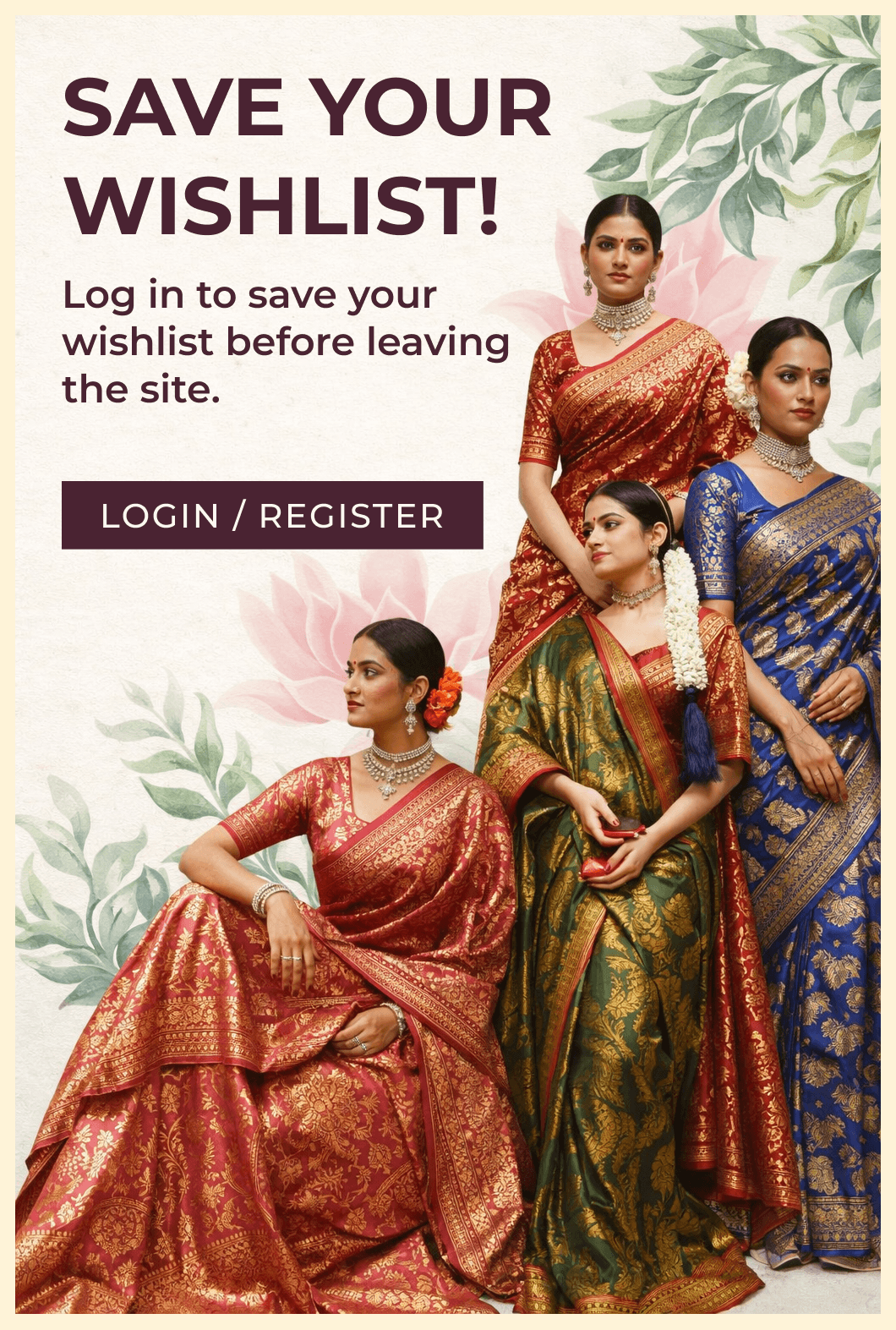
Ask ten different women what a Banarasi saree looks like, and you will receive ten different answers. One will describe a heavy bridal red with dense gold jangla all over the body. Another will mention a sheer ivory organza that drapes like mist at a winter reception. A third will tell you about the fluid georgette she wears to the office on special Fridays — lightweight, understated, unmistakably Banarasi in its craftsmanship.
They are all correct. That is the most misunderstood thing about Banarasi sarees — the word is not a single description. It is an entire universe of weaves, fabrics, patterns, and weights, each with its own character, occasion, and story.
This guide exists to map that universe. Whether you are buying your first Banarasi saree, building a trousseau, choosing a gift for someone who deserves something exceptional, or simply trying to understand what separates a Katan from a Georgette from an Organza — read this once, and you will never feel uncertain in front of a Banarasi saree again.
At Kathanvi, we carry all six major types of Banarasi sarees in our launch collection — each sourced directly from karigar families in Varanasi. This guide is built around those types, their fabrics, their personalities, and exactly when to wear each one.
Before we go deep into each type, here is a full comparison table — optimised for quick decisions. Use this if you already have a sense of what you need and want to navigate directly to the right section.
|
Type |
Fabric Feel |
Weight |
Best For |
Price Starts at |
|---|---|---|---|---|
|
Katan Silk |
Crisp, structured |
Heavy |
Weddings, Bridal |
₹4,000 |
|
Georgette |
Fluid, flowing |
Light-Medium |
Office, Parties |
₹2,500 |
|
Organza / Kora |
Sheer, stiff |
Very Light |
Receptions, Fusion |
₹2,000 |
|
Tissue |
Metallic, iridescent |
Light |
Evening, Photography |
₹7,000 |
|
Shattir |
Subtle, refined |
Medium |
Workplace, Daytime |
₹2,500 |
|
Butidar / Jangla |
Rich, ornate |
Heavy |
Bridal, Heirloom |
₹5,500 |
Banarasi sarees are categorised primarily by their base fabric — the silk used as the canvas on which the weaver works. Within each fabric type, further variation comes from the pattern (butidar, jangla, shikargah) and the zari technique (kadhwa, cutwork, tissue). Understanding the fabric first is the most useful place to begin.
If Banarasi weaving were a dynasty, Katan silk would be its throne. Katan is the oldest and most revered of all Banarasi silk varieties — a pure silk fabric woven from tightly twisted threads in both the warp (the vertical threads on the loom) and the weft (the horizontal threads woven across). This double-twist construction gives Katan its defining character: a crisp, structured drape with a surface that catches light without being overtly reflective.
Katan Banarasi sarees are the heaviest of all types. That weight is not a flaw — it is a feature. The density of the silk, combined with the structural zari brocade woven directly into the fabric, gives Katan sarees a presence that no lighter fabric can replicate. When a Katan Banarasi enters a room, it does not need to announce itself.
Historically, Katan was the fabric of Mughal courts and royal trousseaux. Today, it remains the first choice for brides, for heirloom gifting, and for any occasion where a woman wants to wear something that will be remembered.
KATAN SILK — AT A GLANCE
Fabric Feel: Crisp, structured, substantial — holds its shape beautifully when draped
Weight: Heavy — the heaviest Banarasi fabric type
Zari Work: Rich gold or silver brocade, woven structurally into the fabric
Signature Motifs: Jangla, Butidar, Shikargah — all pattern types work on Katan
Best Occasions: Weddings, bridal trousseau, sangeet, religious ceremonies, formal gifting
Ideal For: Brides, mothers of the bride, heirloom pieces
Care: Dry clean only — do not wash at home
Kathanvi Price Starts at: ₹4,500
A word on what to expect from Katan: first-time wearers sometimes find it stiff initially. This is not a defect — it is what pure silk feels like before it has been worn and settled. After a few hours of wear, Katan softens beautifully and moulds to the body. An experienced wearer will tell you that Katan only gets better with age.
Georgette changed everything. When Banarasi weavers began adapting their craft to georgette silk — a crêpe-textured fabric with a slightly rough, matte surface — they opened the door to an entirely new audience: the working woman, the younger bride, the woman who loves Banarasi craftsmanship but lives a life that requires something she can actually move in.
Georgette is created through a specific twist pattern in the threads — alternating S-twist and Z-twist — that gives the fabric its characteristic pebbled surface and fluid drape. Unlike Katan, which holds its shape, Georgette flows. It settles around the body rather than sitting on it. It is forgiving in a way that heavier silks are not, and it is significantly easier to drape and carry for extended periods.
The brocade work on Georgette Banarasi sarees is just as intricate as on Katan — the difference is in the base fabric, not the artistry. A skilled Varanasi weaver working on Georgette must actually adapt his technique to accommodate the more elastic, fluid base, which many consider technically more demanding than weaving on Katan.
GEORGETTE — AT A GLANCE
Fabric Feel: Fluid, flowing, slightly textured surface — forgiving and easy to wear
Weight: Light to medium — comfortable for all-day wear
Zari Work: Full brocade work — same artistry as Katan on a lighter base
Signature Motifs: Butidar and smaller-scale patterns work especially well
Best Occasions: Office events, dinner parties, festivals, travel, casual elegance
Ideal For: Working women, younger buyers, first-time Banarasi wearers
Season: Year-round — particularly good for spring and autumn occasions
Kathanvi Price Starts at: ₹2,500
If you are buying your first Banarasi saree and feel uncertain about handling a heavy silk, a Georgette Banarasi is the perfect entry point. The craft is fully authentic, the origin is Varanasi, and the draping experience is forgiving enough to build confidence. Many women who begin with Georgette become lifelong Banarasi collectors — it is a gateway, not a compromise.
Organza — called Kora in Varanasi’s weaving vocabulary — is the most visually distinctive of all Banarasi fabrics. It is a sheer, stiff, almost translucent silk that creates sarees with a gossamer body and a sculptural quality unlike anything else in Indian textile tradition. Where Katan commands and Georgette flows, Organza floats.
The stiffness of Organza is inherent in the fabric’s construction — high-twist threads woven at a tight angle create a fabric that holds its shape in three dimensions. This makes Kora Banarasi sarees ideal for contemporary draping styles that rely on volume and structure. The pallu, when draped over the shoulder, fans out with a natural elegance that photographers adore.
Kora Banarasi sarees are especially beloved among younger buyers and NRI women who want a Banarasi saree that reads contemporary rather than traditional. The sheer base means the zari motifs appear to float in light rather than sit on fabric — an effect that is uniquely beautiful and immediately recognisable.
ORGANZA / KORA — AT A GLANCE
Fabric Feel: Sheer, stiff, slightly crisp — the saree that holds its own shape
Weight: Very light — the lightest Banarasi silk type
Zari Work: Motifs appear to float in light against the sheer base
Signature Motifs: Butidar (small scattered motifs) complement the sheer base beautifully
Best Occasions: Receptions, cocktail events, summer weddings, fusion occasions
Ideal For: Contemporary dressers, NRI buyers, fusion stylists, photography
Travel: Exceptional — packs lightly, arrives without heavy creases
Kathanvi Price Starts at: ₹2,000
For NRI buyers specifically, Kora Banarasi sarees are our most recommended first purchase. They travel beautifully — lightweight for packing, resilient against the minor folding stresses of international shipping — and the sheer contemporary aesthetic translates effortlessly to both Indian and Western occasion contexts. A Kora Banarasi with a contemporary blouse and minimal jewellery is one of the most elegant ensembles a woman can wear anywhere in the world.
Tissue Banarasi sarees are unlike any other fabric in the Banarasi canon. In most saree types, the zari appears in specific motifs — borders, butis, pallu — against a plain or textured silk ground. In Tissue sarees, the metallic thread runs through the entire base fabric itself, creating an all-over iridescence that makes the saree shimmer from every angle, under every light, with every movement.
The result is a saree that looks like it was woven from light. Tissue Banarasi sarees are the most visually dramatic type in the entire Banarasi repertoire — and they photograph with a quality that has made them a particular favourite in the age of Instagram and wedding cinematography.
Despite their opulent appearance, Tissue sarees are relatively lightweight compared to Katan. The metallic base threads are finer than zari brocade work, and the fabric drapes with a fluid shimmer rather than a structured weight. This combination of visual drama and comfortable wearability makes Tissue sarees one of the most versatile formal choices in the collection.
TISSUE — AT A GLANCE
Fabric Feel: Metallic throughout — fluid shimmer with every movement
Weight: Light to medium — more wearable than it looks
Zari Work: Zari woven into the base fabric itself, not just motifs
Signature Colours: Gold, silver, champagne, rose gold — the classic Tissue palette
Best Occasions: Evening events, receptions, sangeet, Diwali, photography occasions
Ideal For: Statement dressing, evening formality, women who love shimmer
Kathanvi Price Starts at: ₹3,000
A common question about Tissue sarees: will I look overdressed? The honest answer is that Tissue sarees are inherently formal — but the formality is in the shimmer, not in the heaviness. Pair a gold Tissue Banarasi with minimal jewellery and a clean blouse, and the saree does all the work. This is dressing by subtraction — letting a single extraordinary piece speak for itself.
Among all Banarasi types, Shattir is perhaps the least known — and the most underappreciated. In Shattir weaving, the zari thread is worked entirely on the reverse side of the fabric, creating a surface that shimmers subtly rather than gleaming overtly. The result is a saree with a refined, toned-down lustre — Banarasi craftsmanship made quiet on purpose.
The technique is genuinely sophisticated. Using the zari only on the reverse requires exceptional precision from the weaver — any misalignment shows through to the face of the fabric. The karigars who specialise in Shattir work are among the most skilled in Varanasi, and the sarees they produce reward close inspection in a way that immediately obvious brocade does not.
Shattir Banarasi sarees are ideal for women who love the heritage of Banarasi weaving but prefer their clothing to speak softly. They are the Banarasi saree for the boardroom, for daytime occasions where heavy gold would feel out of place, for women whose aesthetic gravitates toward quiet luxury rather than overt display.
SHATTIR — AT A GLANCE
Fabric Feel: Smooth, refined — subtle sheen rather than overt shimmer
Weight: Medium — comfortable for extended daytime wear
Zari Work: Reverse-side zari technique — surface shimmer is understated and refined
Signature Aesthetic: Quiet luxury — Banarasi craft for the minimalist
Best Occasions: Workplace events, daytime functions, corporate gifting, subtle celebrations
Ideal For: Minimalist dressers, professional women, collectors of understated craft
Kathanvi Price Starts at: ₹2,500
If you have ever wanted to wear a Banarasi saree to work but felt that the gold was too much for a professional setting, Shattir is your answer. The craftsmanship is entirely present — the trained eye will see it immediately — but the presentation is calibrated for spaces where restraint is a virtue. This is the Banarasi saree that earns compliments by revealing itself slowly.
Butidar and Jangla are not fabric types — they are the two defining pattern languages of the Banarasi weaving tradition, and they deserve their own section because they represent opposite ends of the design spectrum while both being equally central to what makes a Banarasi saree distinctly itself.
Butidar — from buti, meaning small motif — describes sarees where individual design elements are scattered across the body of the fabric in a repeat pattern. A classic butidar might have a single flowering sprig repeating every few centimetres, or a small paisley placed at measured intervals. The background between the motifs is clear, giving the design room to breathe. Butidar is the more contemporary of the two styles, and it adapts beautifully to minimalist and modern aesthetics.
Jangla — from the Persian word for jungle or dense garden — is the opposite entirely. A Jangla saree covers the entire body of the fabric with dense, interlocking floral and vine motifs drawn directly from the garden imagery of Mughal art. There is no empty ground — every centimetre of fabric is engaged with pattern. A full Jangla Banarasi saree on Katan silk, woven by a master karigar, is one of the most labour-intensive textile objects that any Indian craft tradition produces.
BUTIDAR & JANGLA — AT A GLANCE
Butidar Pattern: Scattered individual motifs — restrained, contemporary, versatile
Jangla Pattern: Dense all-over florals — opulent, traditional, heirloom-quality
Base Fabrics: Both patterns appear on Katan, Georgette, Organza, and Tissue
Weaving Time: Butidar: 2–7 days. Jangla: 2–12 weeks depending on complexity
Best For Butidar: Modern occasions, office, younger buyers, first Banarasi sarees
Best For Jangla: Bridal trousseau, heirloom gifting, serious collectors
Kathanvi Price Starts at: ₹5,000 for Jangla; ₹2,500 for Butidar
The most important thing to understand about Jangla work is what it represents in terms of karigar time. A dense Jangla pattern on Katan silk can take a single weaver working full days anywhere from three weeks to three months to complete. The price of a Jangla Banarasi is not arbitrary — it is a precise function of the number of hours a skilled human being spent creating it. When you hold a Jangla saree, you are holding weeks of someone’s working life.
Knowing the types is half the answer. The other half is knowing which type fits your specific situation. Here is a practical guide mapped across the questions most buyers actually ask.
Beyond fabric type, Banarasi sarees are further distinguished by their motifs — the design vocabulary drawn from five centuries of cultural synthesis. Understanding these patterns helps you read a saree’s heritage at a glance.
Buta / Buti The foundational Banarasi motif — a stylised flowering plant or sprig, derived from Persian garden imagery. Appears singly (buti) in butidar sarees or in repeat clusters. The most versatile and widely used motif in the entire Banarasi vocabulary.
Kalga / Kairi The mango or paisley shape that is one of the oldest continuously used textile motifs in South Asia. In Banarasi work, the kalga appears most prominently in borders and pallu, often with internal detailing woven in contrasting zari.
Jangla As described above — dense all-over floral and vine coverage inspired by Mughal garden paintings. The most labour-intensive pattern in the Banarasi tradition.
Shikargah A hunting scene pattern — featuring animals, birds, trees, and sometimes human figures in a continuous narrative across the fabric. Shikargah Banarasi sarees are among the rarest and most collectible, requiring exceptional technical skill.
Jali / Lattice A geometric lattice or grid pattern, inspired by the pierced stone screens (jali) of Mughal architecture. Jali work in Banarasi sarees creates a beautiful interplay between the positive thread pattern and the negative space of the silk ground.
Meenakari Multi-coloured thread work woven alongside gold zari, creating a pattern that resembles the enamel inlay work of Rajasthani jewellery. Meenakari Banarasi sarees are among the most vibrant and visually complex pieces in the tradition.
Kathanvi carries all six types of Banarasi sarees discussed in this guide — Katan Silk, Georgette, Organza, Tissue, Shattir, and the full range of Butidar and Jangla patterns. Every piece is sourced directly from karigar families in Varanasi, quality-verified for fabric authenticity and zari integrity, and priced to make genuine Banarasi weaving accessible rather than exclusive.
Our collection starts at ₹2,000 for Organza Butidar sarees and extends to ₹8,000 for heavy Katan Jangla bridal pieces. Each saree comes with a fabric and origin certificate — not because we are asked for one, but because we believe that knowing what you are wearing is part of the experience of wearing it.
We are a brand that originates from where these sarees are made. That is not a selling point. It is a responsibility. When you buy from Kathanvi, you are buying from the source — and the karigar at the other end of that transaction is receiving fair payment for extraordinary work.
Browse the full Kathanvi Banarasi saree collection and use this guide to find exactly the type and price point that is right for you.
Q: What are the different types of Banarasi sarees?
A: The main types of Banarasi sarees, classified by fabric, are: Katan Silk (the heaviest, most traditional), Georgette (fluid and contemporary), Organza or Kora (sheer and lightweight), Tissue (all-over metallic shimmer), and Shattir (reverse-side zari for subtle luxury). By pattern, the two primary categories are Butidar (scattered motifs) and Jangla (dense all-over florals). All types are handwoven in Varanasi.
Q: Which type of Banarasi saree is best for a wedding?
A: Katan Silk Banarasi sarees with Jangla or Butidar patterns are the best choice for brides. They are the heaviest, most structured type with the richest gold zari work, designed to hold their drape through a long ceremony. For wedding guests, Georgette or Tissue Banarasi sarees offer elegance without competing with the bride.
Q: Which Banarasi saree is lightest to wear?
A: Organza (Kora) Banarasi sarees are the lightest type, making them ideal for summer weddings, travel, and women who find heavier silks uncomfortable. Georgette Banarasi sarees are the second lightest and the most versatile for everyday and semi-formal occasions.
Q: What is the difference between Butidar and Jangla Banarasi sarees?
A: Butidar Banarasi sarees feature scattered individual motifs (buti) across a relatively clear fabric ground — a more restrained, contemporary look. Jangla Banarasi sarees cover the entire fabric surface with dense, interlocking floral and vine patterns inspired by Mughal garden art. Jangla is more labour-intensive, typically more expensive, and associated with bridal and heirloom pieces.
Q: What is a Shattir Banarasi saree?
A: A Shattir Banarasi saree uses a weaving technique where the zari (metallic thread) is worked on the reverse side of the fabric rather than the face, creating a subtle, refined shimmer instead of an overt gold sheen. Shattir sarees are ideal for professional settings and minimalist dressers who want Banarasi craftsmanship without heavy zari display.
Q: What is a Tissue Banarasi saree?
A: A Tissue Banarasi saree is woven with metallic thread running through the entire base fabric — not just in the motifs — creating an all-over iridescent shimmer. Tissue sarees are among the most visually dramatic Banarasi types and are particularly popular for evening events and photography occasions.
Q: Which Banarasi saree is best for office wear?
A: Georgette Butidar and Shattir Banarasi sarees are the best choices for office wear. Georgette is lightweight and easy to drape, while Shattir’s reverse-side zari technique creates a refined, subtle shimmer appropriate for professional settings. Both avoid the overt gold brocade that can feel too ceremonial for daytime workwear.
Q: Are all Banarasi sarees made of pure silk?
A: Authentic Banarasi sarees are made on a silk base — Katan silk, Georgette silk, Organza silk, or Tissue silk. However, the market contains many imitations made from polyester, viscose, or synthetic blends sold as ‘Banarasi sarees.’ Genuine Banarasi silk passes the burn test (burns slowly, smells like hair, leaves crushable ash) and typically comes with a GI tag or fabric certificate.
Q: What Banarasi saree should I buy as my first?
A: For a first Banarasi saree, Georgette Butidar is the most recommended choice. It is lightweight and forgiving to drape, the brocade work is fully authentic, it is versatile across occasions from festivals to office events, and the price point (starting around ₹2,500) makes it an accessible entry point into genuine Banarasi weaving.
Q: Can Banarasi sarees be worn in summer?
A: Yes. Organza (Kora) and Georgette Banarasi sarees are both excellent for summer wear. Organza is the lightest Banarasi fabric and the most breathable. Georgette is slightly heavier but still comfortable in warm weather. Avoid Katan Silk in peak summer — its weight and density are better suited to cooler temperatures.
Katan or Georgette, Butidar or Jangla, Tissue or Kora — what every type of Banarasi saree shares is this: it was made by a human being, on a loom, in Varanasi, using a tradition of craft that has survived every disruption that five centuries could deliver. Each fabric type is a different expression of the same reverence for silk and skill that has defined this city’s contribution to the world.
At Kathanvi, we believe that every woman who wants to own a genuine Banarasi saree should be able to — not just those who can afford the most expensive Katan Jangla, but also the woman who wants her first Georgette Butidar, the bride building her trousseau piece by piece, and the NRI daughter who wants to carry something real from home.
Use this guide, ask us questions, and let us help you find the right type. The right Banarasi saree is not the most expensive one — it is the one that belongs to your life.
All Sales Are Final
We do not accept returns or refunds once an order is placed.
Order Cancellation
Orders cannot be cancelled after confirmation.
Damaged Product Exchange
Store Credit Only
No cash refunds. Only store credit is issued.