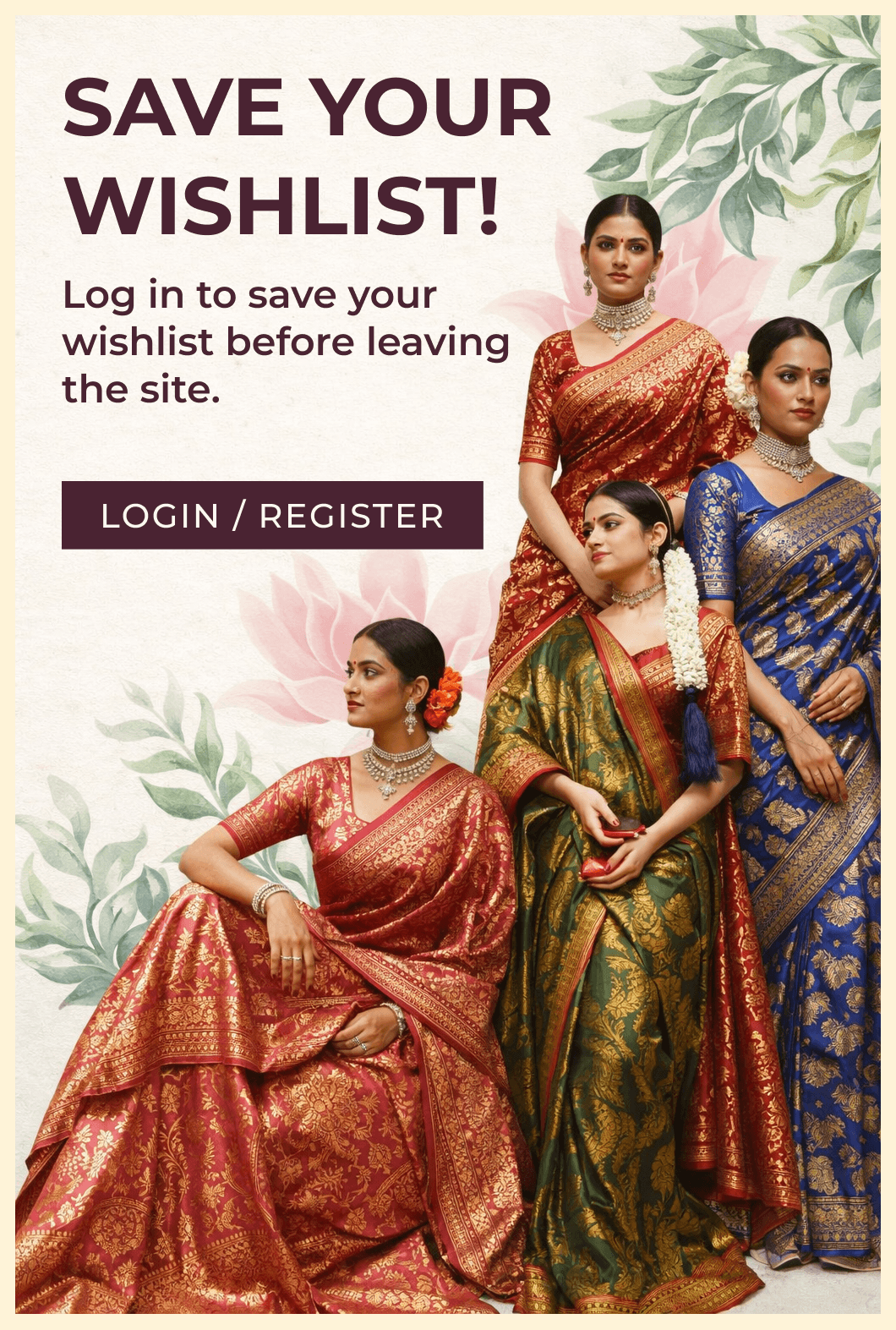
There is a moment — one that almost every Indian woman knows — when a Banarasi saree enters a room before its wearer does. The shimmer of real silk, the whisper of brocade catching the light, the weight of gold zari that feels less like fabric and more like heritage. For over five centuries, the Banarasi saree has not merely been worn. It has been inherited, gifted, mourned in, celebrated in, and passed down like the most sacred of family stories.
But what exactly is a Banarasi saree? Where does it come from? Why does it cost what it costs — and how do you tell a genuine one from an imitation? Whether you are a first-time buyer, a bride searching for her trousseau, or someone living far from India who wants to carry a piece of home, this guide answers every question you have — and several you have not yet thought to ask.
At Kathanvi, we were born in Banaras. This is not a marketing line. It is the reason we exist — to bring the living craft of Varanasi’s weavers to every woman who deserves to own it. Consider this guide our first gift to you.
1. What Is a Banarasi Saree? (The Short Answer, Built for Search)
A Banarasi saree is a handwoven silk saree made in Varanasi (historically called Banaras), Uttar Pradesh, India. It is distinguished by its rich silk base, intricate gold and silver zari (metallic thread) brocade work, fine Mughal-inspired motifs, and a heavy, lustrous texture. Banarasi sarees hold a Geographical Indication (GI) tag — meaning only sarees made by weavers in and around Varanasi can legally be called “Banarasi.”
This GI tag, granted in 2009, is the same kind of legal protection that guards French Champagne or Darjeeling Tea. It is not ceremonial — it is the single most important mark of authenticity you should look for when buying a Banarasi saree.
The saree typically measures between 5.5 to 6.3 metres in length, with a distinct pallu (the decorated end draped over the shoulder), elaborate borders, and a body woven with motifs ranging from the classic buta (floral sprig) to the more ornate jangla (dense floral jungle) and shikargah (hunting scene) patterns.
2. The History of Banarasi Sarees — 500 Years of Living Craft
The story of the Banarasi saree is inseparable from the story of Varanasi itself — one of the oldest continuously inhabited cities on earth. Textile trade flourished here as far back as the Vedic period, but it was the arrival of Mughal influence in the 15th and 16th centuries that gave Banarasi weaving its defining character.
Mughal emperors, particularly Akbar, were passionate patrons of fine textiles. Persian artisans and design vocabularies merged with local weaving traditions along the banks of the Ganga. The result was a new aesthetic: silk as a canvas, and gold as the ink. Motifs of flowering vines, kalga (mango paisley), and geometric jali (lattice) work — all hallmarks of Mughal architecture — were translated into thread.
By the 17th century, Banarasi brocade was being exported to royal courts across Asia and the Middle East. In the 18th and 19th centuries, patronage from Nawabs and the Maratha aristocracy kept the craft not just alive but thriving. Even today, the narrow lanes of Varanasi’s Madanpura, Lallapura, and Peeli Kothi neighbourhoods are home to generations of weavers — karigar families whose grandparents’ grandparents sat at the same kind of pit loom.
The GI tag of 2009 was a modern recognition of this ancient continuity. It said, officially and legally: this craft belongs to this place, and to the hands that practise it here.
3. Types of Banarasi Sarees — A Complete Classification
One of the most common questions from first-time buyers is: which type of Banarasi saree should I choose? The answer depends on the occasion, the season, your comfort with draping weight, and your personal aesthetic. Here is a complete breakdown of every major type.
3.1 Katan Silk Banarasi
Katan is the purest and most traditional form of Banarasi silk. It is made from tightly twisted silk threads — both in the warp (lengthwise) and weft (crosswise) — giving it exceptional durability and a distinctive crisp drape. Katan Banarasi sarees are the heaviest and most formal of all types, and they are the category most associated with bridal wear.
Best for: Weddings, Shadi trousseau, formal occasions, gift-giving
Weight: Heavy
Price range starts at Kathanvi: INR 4000
3.2 Georgette Banarasi
Georgette Banarasi sarees use a crêpe-textured silk that is lighter, more fluid, and considerably easier to drape than Katan. Despite the lighter base, the zari and brocade work is equally intricate. These are the sarees that have made Banarasi weaving relevant to modern, working women who want elegance without the ceremonial weight.
Best for: Office occasions, dinner parties, festive events, travel
Weight: Light to medium
Price range starts at Kathanvi: ₹2500
3.3 Organza (Kora) Banarasi
Organza, or Kora, is a sheer, stiff silk that creates sarees with an almost translucent body. The fabric holds its shape beautifully, making it ideal for contemporary draping styles. Kora Banarasi sarees are increasingly popular among younger buyers and NRI women who want a Banarasi saree that feels contemporary rather than traditional.
Best for: Receptions, cocktail events, fusion styling, summer weddings
Weight: Very light
Price range starts at Kathanvi: ₹2,000
3.4 Shattir Banarasi
Shattir Banarasi sarees are woven using a technique where the zari thread is used only on the reverse side of the fabric, creating a subtler surface shimmer rather than an overt gold sheen. This makes them perfect for women who love the craftsmanship of Banarasi weaving but prefer understated aesthetics.
Best for: Workplace events, daytime occasions, subtle elegance
3.5 Tissue Banarasi
Tissue sarees are woven with metallic threads throughout the base fabric — not just in the motifs — giving them a full-body iridescent shimmer. They are among the most visually dramatic Banarasi sarees and catch light in a way that photographs exceptionally well.
Best for: Evening events, receptions, photography, festive occasions
3.6 Jangla Banarasi
Jangla is not a fabric type but a pattern classification. A Jangla Banarasi features dense, all-over floral and vine motifs covering the entire body of the saree — inspired directly by Mughal garden imagery. Jangla weaving is among the most labour-intensive, often taking a master weaver several weeks to complete a single saree.
Best for: Bridal trousseaux, heirloom gifting, serious collectors
3.7 Butidar Banarasi
Butidar sarees feature scattered small motifs — called buti or buta — across the body of the saree, set against a plain or textured silk ground. This design language is more restrained than Jangla and works beautifully for women who want Banarasi heritage with a contemporary, minimalist sensibility.
Best for: Festivals, casual occasions, modern styling
4. How Is a Banarasi Saree Made? The Craft Behind the Cloth
Understanding how a Banarasi saree is made is understanding why it is priced the way it is — and why it lasts a lifetime if cared for properly.
The process begins with raw silk sourced primarily from South India (Mysore and Bangalore) or China. The silk threads are degummed, dyed in rich colours using both natural and chemical dyes, and then wound onto bobbins for the weaving process.
Master weavers, called naqshabands, create the design first — traditionally as a graph paper pattern, and increasingly today using CAD software that has been adapted to Jacquard loom punch cards. The Jacquard loom, introduced in Varanasi in the 19th century, uses a series of punch cards to control which threads rise and fall during weaving, enabling the extraordinarily complex brocade patterns that define Banarasi work.
The zari — real gold or silver wrapped around a silk or cotton core — is woven in during this process, not embroidered on afterwards. This distinction is crucial: authentic Banarasi zari is structural to the fabric. It cannot peel, fade, or detach the way embroidered embellishments can.
A simple Butidar Banarasi saree takes approximately 2–3 days on a handloom. A medium-complexity piece takes 1–2 weeks. An elaborate Jangla Banarasi with dense all-over motifs can take a single karigar anywhere from 3 weeks to 3 months of uninterrupted work.
Each saree that leaves a Kathanvi karigar’s loom carries that time in it. That is not a metaphor. It is the literal truth of the price.
5. What Makes a Banarasi Saree ‘Authentic’?
The word “authentic” is used so freely in the ethnic wear market that it has nearly lost its meaning. At Kathanvi, we define authenticity across three non-negotiable criteria:
Origin — The saree must be woven in Varanasi and its recognised surrounding areas (Chandauli, Bhadohi, Jaunpur). GI-tagged products meet this criterion.
Material — The base fabric must be genuine silk (Katan, Georgette, Organza, or Tissue), not polyester, viscose, or synthetic blends. Real silk has a natural sheen, warmth to the touch, and a specific burn test response.
Technique — The brocade and zari work must be woven into the fabric on a handloom or power loom using Jacquard technology — not printed, screen-processed, or embroidered as a secondary process.
The easiest consumer test: genuine silk burns slowly, smells like burning hair, and leaves a crushable ash. Polyester melts, shrinks from flame, and smells acrid. If someone is selling you a “Banarasi saree” for ₹500 or ₹800, you are almost certainly holding polyester.
6. Banarasi Sarees for Different Occasions — A Quick Reference
One of the most enduring misconceptions about Banarasi sarees is that they are only for weddings. In reality, the range of fabrics and designs available makes them appropriate for almost every occasion in a woman’s life.
Bridal & Wedding: Katan silk Jangla or Butidar in deep reds, magentas, and royal blues. Heavy zari, full pallu.
Festive (Diwali, Navratri, Eid, Teej): Georgette or Kora Butidar in jewel tones. Medium zari work.
Office & Workwear: Georgette Shattir or subtle Butidar in muted golds, teal, or pastels. Minimal zari.
Receptions & Evening Events: Tissue or Organza sarees in champagne, silver, or rose gold.
NRI & Destination Occasions: Kora or Georgette — lighter weight travels well and photographs beautifully in any setting.
7. Why Banarasi Sarees Are Expensive — And Why That Price Is Honest
The price of a genuine Banarasi saree is not a premium for a brand name. It is a direct reflection of the labour, materials, and time it contains.
Real Katan silk costs significantly more than polyester or even semi-silk alternatives. Genuine zari — gold or silver wrapped around a silk core — is priced by gram weight of precious metal. A skilled karigar earns between ₹400 to ₹800 per day of handloom work. A saree that takes 15 days to complete has 15 days of that expertise woven into every centimetre of its border.
When Kathanvi prices a Katan Banarasi saree at ₹6,500, that price represents the cost of genuine raw silk, real zari, weeks of karigar time, quality checking, and our commitment to paying artisans fairly. It does not include the markup of five intermediaries between weaver and buyer that most retail channels add.
This is why we exist. Buying directly from a brand rooted in Varanasi means the karigar is compensated properly and you receive a genuine saree at a price that makes authentic Banarasi weaving accessible — not a luxury reserved for the few.
8. Banarasi Sarees and the NRI Woman — Carrying Home Across Borders
For Indian women living abroad, the Banarasi saree carries a weight that goes beyond silk and zari. It is the saree worn at a daughter’s naming ceremony in Toronto, at a Diwali puja in London, at a wedding in New Jersey where the bride wanted nothing less than what her grandmother wore.
The practical reality of buying Banarasi sarees from outside India has historically been difficult — unreliable sellers, inability to assess fabric quality through a screen, customs confusion, and sarees that arrive looking different from their photographs. Kathanvi was built with this buyer in mind.
For NRI buyers, we recommend Georgette and Kora Banarasi sarees as first purchases — they travel exceptionally well, are lighter for packing, and the contemporary designs translate beautifully to both Indian and Western occasion dressing. Our packaging is designed for international shipping, and every saree comes with a detailed fabric and care certificate.
9. How to Care for a Banarasi Saree
A genuine Banarasi saree, properly cared for, does not have a lifespan. It has a legacy.
Dry clean only — never machine wash. The zari oxidises with direct water and detergent exposure.
Store wrapped in a clean muslin or cotton cloth — never in plastic, which traps humidity and can damage silk fibres.
Do not fold along the same lines repeatedly. Rotate your fold pattern to prevent permanent crease lines in the silk.
Store in a dark, dry place away from direct sunlight. Silk colours, particularly natural dyes, can fade with UV exposure.
Air your sarees every 3–6 months. A short airing in gentle shade keeps the fabric fresh and prevents mustiness.
10. Kathanvi — Banaras Woven Into Every Thread
Kathanvi is not a brand that sources Banarasi sarees. We are a brand that originates from where they are made. Our roots are in Varanasi — the city, the craft, the karigar families who have been weaving for generations. Every saree in our collection is sourced directly from these weavers, quality-verified, and brought to you with complete transparency about fabric, technique, and origin.
Our name — Kathanvi — is itself a story. In the spirit of Katha & Karigari, we believe that every saree has a tale to tell. Our purpose is to make sure that tale reaches the woman who was always meant to wear it — whether she lives in Lucknow, London, or Los Angeles.
Explore our Banarasi saree collection to find authentic, GI-tagged, karigar-crafted sarees starting at ₹2,000. Every piece comes with a fabric certificate, careful packaging, and the assurance that what you are holding is the real thing.
Frequently Asked Questions About Banarasi Sarees
Q: What is a Banarasi saree?
A: A Banarasi saree is a handwoven silk saree made in Varanasi (Banaras), India. It is known for its rich silk fabric, gold and silver zari brocade work, and intricate Mughal-inspired motifs. Banarasi sarees hold a Geographical Indication (GI) tag, meaning only sarees made by weavers in and around Varanasi can be legally called Banarasi.
Q: What makes Banarasi sarees special?
A: Banarasi sarees are special because of their combination of genuine silk, real zari (metallic thread), and intricate handwoven brocade patterns — a craft tradition that has been practiced in Varanasi for over 500 years. Each saree is a unique handcrafted piece that can take days to weeks to complete.
Q: How do I know if a Banarasi saree is original?
A: To identify an original Banarasi saree: (1) Check for a GI tag or authenticity certificate, (2) Perform the silk burn test — real silk burns slowly, smells like hair, and leaves crushable ash, (3) Look at the reverse side — authentic zari brocade shows the weave structure on the back, not just the front, and (4) Be wary of prices below ₹1,500 — genuine handwoven Banarasi sarees cannot be made that cheaply.
Q: Which type of Banarasi saree is best for a wedding?
A: Katan silk Banarasi sarees are considered the best for weddings. They are the heaviest, most formal type with the richest zari work. Deep reds, magentas, royal blues, and ivory are the most traditional bridal colours. Jangla and Butidar patterns are the most popular for bridal wear.
Q: Are Banarasi sarees only for weddings?
A: No. While Katan Banarasi sarees are ideal for weddings, lighter varieties like Georgette and Organza (Kora) Banarasi sarees are perfect for office wear, festive occasions, dinner parties, and casual styling. The range of Banarasi weaves makes them suitable for nearly any occasion.
Q: What is the price of a genuine Banarasi saree?
A: Genuine Banarasi sarees start at approximately ₹2,000 for Organza or Georgette varieties and can go up to several lakhs for heavy Katan silk Jangla sarees. At Kathanvi, our authentic karigar-woven Banarasi sarees start at ₹2,000 — making genuine Banarasi weaving accessible without compromising on authenticity.
Q: Can Banarasi sarees be bought online by NRI customers?
A: Yes. Banarasi sarees can be shipped internationally. For NRI buyers, Georgette and Kora (Organza) Banarasi sarees are recommended as they are lighter, travel better, and are versatile for both Indian and international occasions. Always buy from brands that provide fabric certificates and clear return policies.
Q: How should I store a Banarasi saree?
A: Store Banarasi sarees wrapped in clean muslin or cotton cloth (never plastic), in a dark and dry location away from direct sunlight. Dry clean rather than wash at home. Air the saree every few months and avoid repeatedly folding along the same lines to preserve the silk and zari.
Q: What is the GI tag for Banarasi sarees?
A: The Geographical Indication (GI) tag for Banarasi sarees was granted in 2009 by the Government of India. It legally certifies that only sarees woven in Varanasi and specific surrounding districts (Chandauli, Bhadohi, Jaunpur, and Mirzapur) can be called Banarasi sarees. This is similar to how only sparkling wine from the Champagne region of France can be called Champagne.
Q: What is the difference between Banarasi and Kanjivaram sarees?
A: Banarasi sarees originate from Varanasi and feature Mughal-inspired motifs with gold/silver zari on a silk base. Kanjivaram sarees come from Kanchipuram in Tamil Nadu and are known for bold contrasting borders and heavier silk. Both are premium silk sarees ideal for weddings, but they differ significantly in motif style, weaving technique, and regional heritage.
Final Word: A Saree Is Never Just a Saree
The Banarasi saree has outlasted empires, survived industrialisation, and adapted to every era without losing the essential quality that makes it irreplaceable: it is made by human hands, with human skill, in a city that has never stopped believing in the sanctity of craft.
When you choose a Banarasi saree, you are not buying fabric. You are continuing a tradition that a karigar in Varanasi has kept alive for you — often in difficult circumstances, always with extraordinary skill. At Kathanvi, we consider it our responsibility to be the honest bridge between that karigar’s loom and your wardrobe.
Explore the Kathanvi collection. Ask us anything. We are Banaras, and we are here.
All Sales Are Final
We do not accept returns or refunds once an order is placed.
Order Cancellation
Orders cannot be cancelled after confirmation.
Damaged Product Exchange
Store Credit Only
No cash refunds. Only store credit is issued.